California’s Packaging Rules Took Effect. Your Case Pack Changes.
Ever packed for a trip and then learned the airline shrank its carry-on size? Everything still fits in a bag. Just not that bag. California’s packaging law does something similar to a brand’s shipping cartons. The product inside stays the same, while the case around it, the pallet under it and the kit it ships in all start answering to a new set of rules. Most of that change shows up first on the warehousing logistics floor, long before a shopper notices anything.
What took effect in California
The Plastic Pollution Prevention and Packaging Producer Responsibility Act, better known as SB 54, was signed into law on June 30, 2022. Its permanent regulations were approved by the Office of Administrative Law and took effect on May 1, 2026 (CalRecycle, May 1, 2026). Producers then had until June 1, 2026 to register with Circular Action Alliance, the producer responsibility organization running the program, register with CalRecycle as an independent producer, or apply for the small producer exemption. That exemption covers producers with less than $1 million in California gross sales (Mayer Brown, June 2026). Any brand whose product moves through a California warehouse and onto California shelves should know which of those 3 paths it took.
The targets come next. Measured against what was sold in 2023, plastic packaging has to be cut at least 10% by January 1, 2027, 20% by 2030 and 25% by 2032, counted both by weight and by number of plastic components (California Public Resources Code section 42057). By 2032, all single-use packaging sold in the state must be recyclable or compostable, and 65% of single-use plastic packaging must actually be recycled (Mayer Brown, June 2026). Circular Action Alliance is responsible for hitting those targets across its members, and it does that through enforceable agreements with each brand owner, so the work still lands on brands. The physical side of it runs straight through logistics and warehousing.
Why the case pack is where it lands
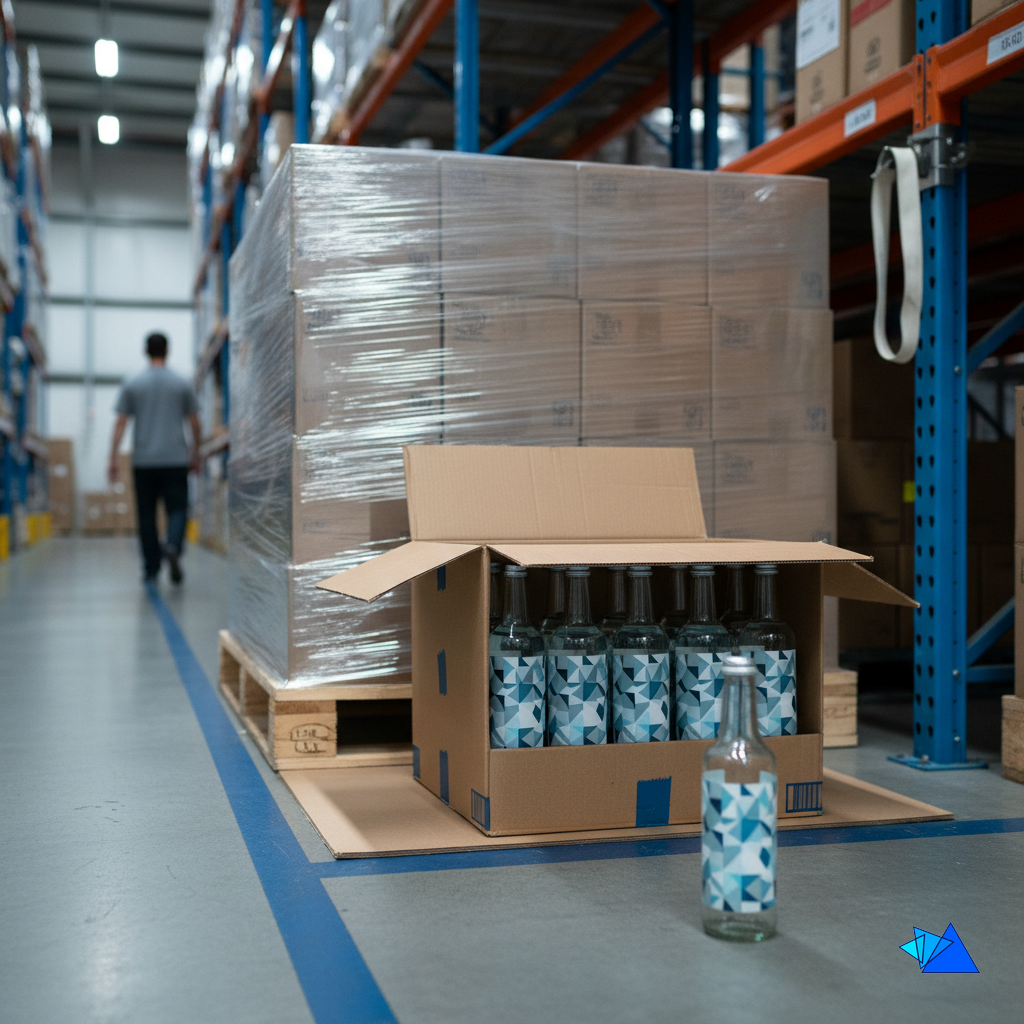
Here’s the part that matters on the dock. The statute defines packaging broadly, and sales packaging, grouped packaging and transport packaging all fall inside the definition (California Public Resources Code section 42041). Translate that into warehouse language and it covers the retail unit, the case pack holding 6 or 12 of them, and the wrap and slip sheets holding a pallet together. Every one of those layers passes through a fulfillment warehouse on its way to a store shelf or a front porch.
Notice the word “components.” The law counts plastic pieces, not only pounds, so a multipack with a plastic tray and a film overwrap could carry 2 plastic components, and removing either one counts. The statute lists the approved methods: eliminating a plastic component, shifting to reusable or refillable packaging, concentration, lightweighting, bulk or large format packaging, and switching to nonplastic materials. At least 10% of all plastic packaging sold has to be cut by eliminating a component or shifting to reuse and refill, so 10 of the 25 points have to come from those 2 methods, and the January 1, 2027 checkpoint already requires 2% through reuse or refill (California Public Resources Code section 42057). Nearly every one of those methods changes how product gets packed, which is why they reach pick and pack fulfillment teams so fast.
Case count: a new box changes the math

Swap a shrink bundle for a corrugated tray and the case changes shape. Drop an inner plastic sleeve and it may shrink. Concentrate a liquid and the same case might hold 16 units instead of 12. Each change rewrites the item master: case dimensions, case weight, units per case and the pick rules built on all three. Whoever runs a brand’s warehouse and distribution services needs those numbers before the first redesigned pallet arrives, because receiving checks every case against them.
Bulk and large format packaging is on the statute’s list too. For a brand, that might mean a club store size in place of 2 smaller units. On the floor it means heavier cases, new slotting and often a new pallet pattern. A change that looks small on a packaging spec sheet can touch every step of warehousing & logistics, from receiving to the outbound dock.
Pallet configuration: wrap, tiers and the reusable exception

The final regulations draw a useful line. Only single-use packaging counts as covered material, so reusable pallets fall outside it. A pallet qualifies when it is designed and marketed for multiple uses, built to last, supported by infrastructure for reuse, and actually recovered, inspected and repaired over many trips (Pallet Enterprise, June 1, 2026). Single-use transport packaging stays inside the law, which puts stretch wrap, slip sheets and other one-trip materials in logistics warehousing under a brighter spotlight.
Then there is the tie and high, the number of cases per layer and layers per pallet. Change the case dimensions and the pattern changes with it. A pattern that once interlocked tightly may need extra wrap to stay stable, which puts plastic right back on the load. Reworking the pallet build alongside the case redesign, rather than after it, keeps a California warehouse from shipping wobbly loads or wrapping its way out of the savings.
Kitting: where plastic components pile up
Variety packs, gift sets and display builds are packaging-dense by design, with inner trays, clamshells, shrink bands and header cards. Every plastic piece is a component. When a brand redesigns a kit, the build instructions at the kitting station change too: different materials, a different sequence and a different labor time per unit. In food logistics, where seasonal variety packs and club store bundles are common, one packaging decision can touch dozens of SKUs at once.
The lawsuit does not stop the clock
On June 22, 2026, 17 states led by Nebraska, joined by the National Association of Wholesaler-Distributors, sued in federal court in the Eastern District of California, arguing SB 54 violates the U.S. and California constitutions (Packaging Dive, June 22, 2026). The plaintiffs filed for a preliminary injunction on August 19, 2026, and the hearing is set for January 15, 2027, 2 weeks after full program implementation begins on January 1, 2027 (EPR Atlas litigation tracker, September 30, 2026). No injunction has been granted, so the regulations remain in force. Building a plan for fulfillment services around a court ruling that may never arrive is a gamble.
What to have ready

So where does a brand start? Build a packaging inventory by SKU that counts plastic components, not only weight. Flag the kits and multipacks carrying the most plastic. Get updated case and pallet specs to the warehouse before redesigned packaging ships, so receiving, slotting and pallet builds are ready on day 1. A brand that brings its logistics and warehousing team into the redesign early avoids paying twice for the same change.
Industry groups are a good place to compare notes. The International Warehouse Logistics Association connects shippers with warehouse operators across North America, and the Warehousing Education and Research Council focuses on warehousing education and research. Both are worth a look for anyone mapping how packaging law reaches the fulfillment warehouse floor.
The law sets the targets. The case pack is where those targets turn into cartons, tiers and kit instructions. Bring the warehouse into the redesign before the first new carton ships, and the change lands once, cleanly, across every step of warehousing logistics.

ABOUT PRISM LOGISTICS: As a warehouse services and warehouse distribution management company, PRISM Logistics provides value added fulfillment and pick & pack services for B2B and B2C operations in California. For more information about PRISM Logistics Warehouse and Distribution services, request a quote and follow on Facebook and LinkedIn.